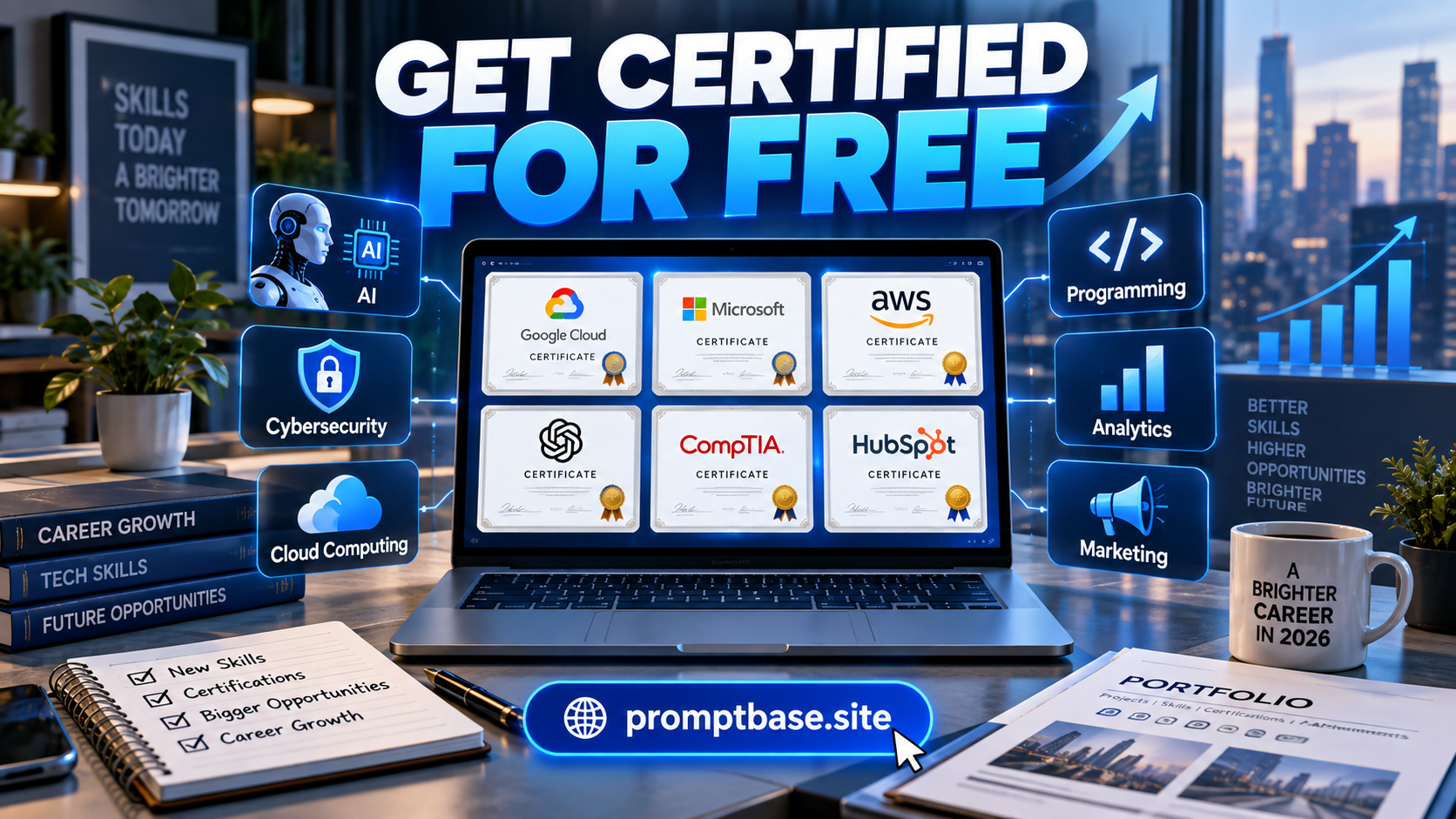

Want to improve your resume without spending hundreds or thousands of dollars on courses?
You are not alone.
The internet is full of people selling expensive certifications and promising that one course will transform your career. Some of them can help. Others are little more than expensive pieces of paper.
The good news is that you do not always need to pay to learn valuable skills.
Several respected organizations offer free training and, in some cases, free certifications that can help you demonstrate useful skills to employers.
But there is an important difference between collecting certificates and building skills.
A certificate by itself will not guarantee you a job. What matters is whether you can use what you learned to solve real problems.
With that in mind, here are six free certifications and learning programs worth looking into in 2026.
 You do not need to become a machine learning engineer to understand artificial intelligence. But having a basic understanding of what AI can and cannot do can be extremely useful.
That is where Elements of AI comes in.
Elements of AI was created by the University of Helsinki in partnership with MinnaLearn. The program was designed to make artificial intelligence easier for ordinary people to understand.
And you do not need to know how to code to get started.
The course introduces important AI concepts such as:
 Those programs can be useful, but they are generally delivered through Coursera and may involve a subscription unless you qualify for financial assistance.
Google also has another platform that many people overlook.
It is called Google Skillshop.
Skillshop provides training for Google's professional products, including tools used in digital marketing and analytics.
For people interested in marketing, ecommerce, advertising, or content, this can be especially useful.
 Cloud computing is now deeply connected to how many large organizations operate.
Hospitals, corporations, government agencies, universities, and other large organizations rely on cloud infrastructure and enterprise software.
Microsoft is a major player in that ecosystem.
Its products include Azure, Microsoft Entra ID, Microsoft Defender, and many other services used by organizations around the world.
The problem is that learning these technologies can become expensive.
You may find yourself paying for courses, practice tests, and certification exams.
But Microsoft provides a way to learn many of these skills for free.
It is called Microsoft Learn.
6. Elements of AI
Artificial intelligence has become one of the biggest topics in business. Companies want to know how AI can improve their operations. Employees are trying to understand how AI will affect their jobs. Managers are investing in AI tools, sometimes before they fully understand how those tools work. That creates a problem.
You do not need to become a machine learning engineer to understand artificial intelligence. But having a basic understanding of what AI can and cannot do can be extremely useful.
That is where Elements of AI comes in.
Elements of AI was created by the University of Helsinki in partnership with MinnaLearn. The program was designed to make artificial intelligence easier for ordinary people to understand.
And you do not need to know how to code to get started.
The course introduces important AI concepts such as:
- Basic logic
- Probability
- Machine learning
- Neural networks
- How AI systems make predictions
- The limitations of artificial intelligence
Why does AI literacy matter?
There is a lot of confusion around artificial intelligence. Some people believe AI can solve almost any problem. Others assume that because an AI system sounds confident, its answer must be correct. Neither assumption is safe. Understanding the fundamentals can help you recognize where AI is useful and where it is likely to cause problems. For example, imagine you are sitting in a business meeting and someone suggests using an expensive AI system to solve a problem that could be handled with a simple spreadsheet. If you understand AI fundamentals, you can ask better questions. What problem are we actually solving? Does AI provide an advantage here? What data does the system need? How reliable are its predictions? What happens when it makes a mistake? That type of understanding can be valuable in almost any modern workplace.What this certification will not do
Elements of AI will not turn you into an AI engineer. You will not finish the course and suddenly be qualified to build the next major AI model. What it can give you is something much more practical for many careers: AI literacy. If you want to add AI knowledge to your resume without learning how to code first, this is a useful place to start.5. Google Skillshop
There is a common misunderstanding about Google's free training. You may have heard people recommend Google's career certificates as a way to learn skills for fields such as data analytics, IT support, or UX design.
Those programs can be useful, but they are generally delivered through Coursera and may involve a subscription unless you qualify for financial assistance.
Google also has another platform that many people overlook.
It is called Google Skillshop.
Skillshop provides training for Google's professional products, including tools used in digital marketing and analytics.
For people interested in marketing, ecommerce, advertising, or content, this can be especially useful.
Why Google Analytics skills matter
Businesses need data. They want to know where their website visitors come from, what people do on their websites, which campaigns generate results, and which marketing activities are wasting money. Google Analytics is one of the major tools used for this work. Google's transition from Universal Analytics to Google Analytics 4 also created a learning curve for many businesses. The interface changed. Reports changed. Events changed. The way marketers think about attribution and measurement also had to change. That created an opportunity for people who were willing to learn the new system. Through Google Skillshop, you can learn concepts such as:- Data streams
- Events
- Reports
- Attribution
- Campaign tracking
- UTM parameters
- Website measurement
One thing to remember
Google updates its products frequently. That means certifications connected to specific Google products may need to be renewed periodically. That is not necessarily a bad thing. Digital marketing changes quickly, so keeping your knowledge current is part of the job. If you are interested in marketing, analytics, advertising, or ecommerce, Google Skillshop is worth exploring.4. HubSpot Academy
What if you want to learn marketing without paying for an expensive marketing course? Take a look at HubSpot Academy. HubSpot is a major company in the marketing and customer relationship management industry. Its free educational platform provides courses covering areas such as:- Content marketing
- Inbound marketing
- SEO
- Email marketing
- Sales
- Lead generation
- Customer relationship management
Learn how modern marketing works
Traditional marketing often depended heavily on interruption. Businesses bought advertisements, cold called potential customers, sent promotional emails, and hoped the right person would respond. Inbound marketing takes a different approach. Instead of constantly chasing customers, businesses create useful content that attracts people who are already looking for information or solutions. That means understanding things like:- Search intent
- Buyer personas
- Content strategy
- Lead generation
- Landing pages
- Email nurturing
- Conversion rates
Why employers may care
When an employer sees marketing certifications on your resume, they still need to determine whether you understand basic marketing concepts. A relevant certification can show that you have at least spent time learning the fundamentals. It does not guarantee a job. But it can help demonstrate that you understand the language of the industry and have taken the initiative to learn outside of school or work. For someone trying to enter digital marketing, content marketing, SEO, or sales, HubSpot Academy can be a practical starting point.3. Microsoft Learn and Cloud Skills Challenges
Cloud computing is now deeply connected to how many large organizations operate.
Hospitals, corporations, government agencies, universities, and other large organizations rely on cloud infrastructure and enterprise software.
Microsoft is a major player in that ecosystem.
Its products include Azure, Microsoft Entra ID, Microsoft Defender, and many other services used by organizations around the world.
The problem is that learning these technologies can become expensive.
You may find yourself paying for courses, practice tests, and certification exams.
But Microsoft provides a way to learn many of these skills for free.
It is called Microsoft Learn.
Learn directly from Microsoft
Microsoft Learn contains learning paths and technical modules covering Microsoft's products and technologies. You can study subjects such as:- Azure
- Security
- Identity
- Cloud computing
- Artificial intelligence
- Data
- Microsoft 365
Why a cloud certification can help
Cloud computing can be intimidating when you are starting out. A foundational certification gives you a structured way to learn the basics. Certifications such as Azure Fundamentals can introduce concepts that are useful for people interested in:- IT support
- Cloud administration
- Technical support
- Cloud computing
- Cybersecurity
- Enterprise technology
2. Harvard CS50
Harvard is one of the most recognized universities in the world. Its traditional programs can cost a huge amount of money. But there is a remarkable alternative for people who want to learn computer science. You can study CS50, Harvard's famous Introduction to Computer Science course, online. The course is available through Harvard's open course resources and can be studied without paying tuition. That does not mean the course is easy. In fact, that is part of its value.What will you learn in CS50?
The course introduces students to fundamental computer science concepts and programming. You can encounter technologies and concepts including:- Scratch
- C
- Python
- SQL
- HTML
- CSS
- JavaScript
- Algorithms
- Data structures
- Web development
The real value of CS50
Programming languages change. Syntax changes. Tools change. Frameworks become popular and then disappear. The ability to think logically and solve problems is much more durable. CS50 forces you to practice that process. You have to read documentation. You have to debug your programs. You have to figure out why something is not working. You have to keep going when the answer is not immediately obvious. That experience can be more valuable than simply memorizing programming commands.What about the certificate?
There is an important distinction here. Completing the free CS50 course is not the same thing as earning a Harvard degree. It does not make you a Harvard graduate or Harvard alumnus. There are also paid verified certificate options through platforms such as edX. The free course certificate should be viewed for what it is: evidence that you completed the course requirements. If you want to build a foundation in computer science, however, CS50 is a valuable educational resource to consider.1. ISC2 Certified in Cybersecurity
Cybersecurity is another field where certifications can matter. Unfortunately, the internet is also full of questionable cybersecurity courses and badges. Some programs promise to turn beginners into cybersecurity professionals after a few hours of videos and a simple online quiz. Real cybersecurity work is considerably more complicated. That is why credentials from established industry organizations can be more meaningful. One organization worth knowing is ISC2. ISC2 is known for cybersecurity certifications, including the CISSP, which is aimed at experienced security professionals. For beginners, ISC2 offers the Certified in Cybersecurity, also known as CC. The certification is designed to introduce foundational cybersecurity knowledge.What does the certification cover?
The exam tests areas such as:- Security principles
- Business continuity
- Disaster recovery
- Access controls
- Network security
- Incident response
- Security operations